
When Results Become Verdicts: Jammu & Kashmir’s Dangerous Obsession with Marks
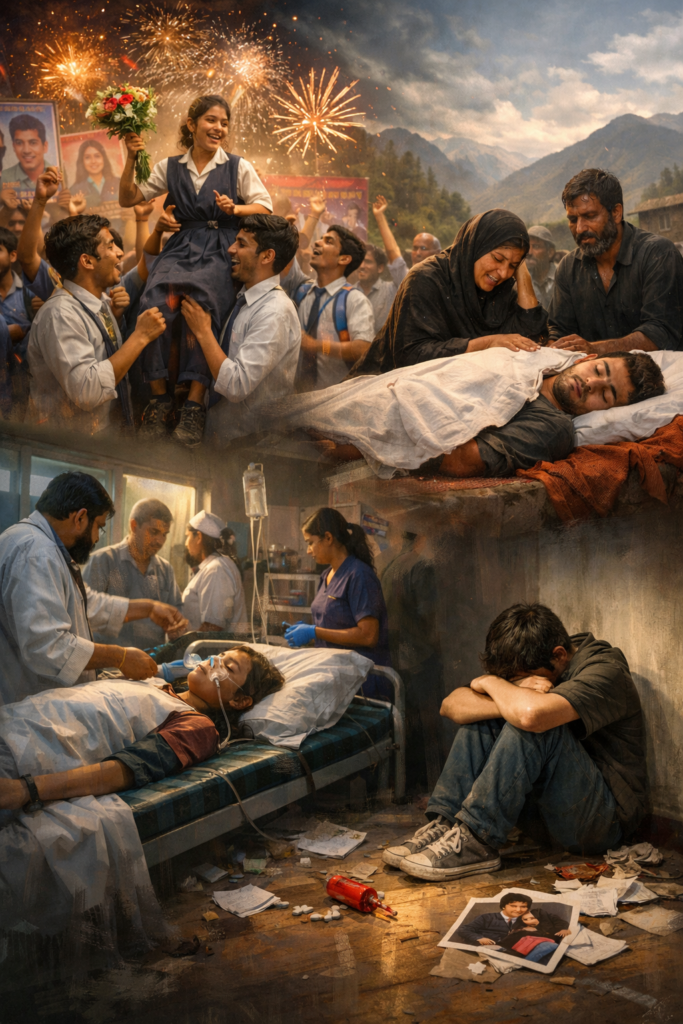
Every year in Jammu & Kashmir, the declaration of Class 10 and 12 board results triggers a familiar ritual. In some homes, loud celebrations erupt. Posters go up. WhatsApp statuses overflow with “proud moment” graphics. And quietly, behind hospital curtains and closed doors, children collapse under a weight they were never meant to carry.
This year, the contrast was brutal.
On January 15, the same day when Class 10 and 12 results were announced, I visited the hospital in Thathri with a patient. Inside the emergency section, I saw something that should shake any sane society: eight to nine Medico-Legal Cases — mostly young girls — brought in after consuming poison because of “bad performance” in board exams. These were not rumours or social media exaggerations. These were real children, lying on hospital beds, their lives hanging on minutes and medical intervention. Doctors managed to save them. That is the only relief in an otherwise horrifying scene.
Now pause and absorb this: eight or nine suicide attempts in a single hospital on a single result day.
This is not coincidence. This is pattern.
A few hours away, in Doda district, that pattern turned fatal.
Seventeen-year-old Revansh Sharma, a Class 12 student from Paryote village, was found dead after reportedly failing in the Economics paper. One subject. One mark sheet. One life lost. Political leaders, including Shakti Raj Parihar, expressed grief and issued statements reminding society that no exam is bigger than a human life. The words were sincere. They were also tragically late.
We repeat these lines after every such death. Then we move on. And the machine keeps grinding.
Celebration Culture with a Hidden Cost
Let’s be honest and uncomfortable. The problem is not success. The problem is how publicly, aggressively, and irresponsibly we perform success.
In Jammu & Kashmir, board results are no longer academic milestones; they have become social events. Children are turned into trophies. Marks are displayed like medals. Families compete in visibility, not values. Schools amplify toppers while quietly discarding those who struggled. Social media finishes the job by converting a private achievement into a public referendum on worth.
This creates a cruel binary:
You are either celebrated, or you are invisible.
Worse — you are ashamed.
Teenagers internalise this faster than adults realise. At 16 or 17, the brain is still under construction. Emotional regulation is weak. Perspective is narrow. When society tells a child — subtly or loudly — that marks equal future, failure feels like annihilation. Not disappointment. Not delay. Erasure.
So when a result goes wrong, the child doesn’t think, “I can try again.” The child thinks, “I am finished.”
That is not academic stress. That is psychological violence.
Hospitals Tell the Truth Society Hides
Hospitals don’t deal in narratives. They deal in bodies.
When multiple students land in emergency wards after results, it exposes a truth that motivational speeches and topper interviews cannot bury. These children were not “weak”. They were overwhelmed. They were cornered by expectations — parental, social, institutional — and they saw no exit except poison, rope, or silence.
And let’s call out a particularly ugly hypocrisy:
Many parents will swear they never pressured their child. Yet they compared marks with neighbours. Posted result cards online. Repeated phrases like “log kya kahenge” and “ek saal barbaad ho gaya”. Pressure doesn’t need shouting. Sometimes it just needs constant judgment.
The Rot Has Started Earlier — Much Earlier
What makes this crisis even darker is that it no longer starts in Class 10 or 12.
I have seen children from Class 5 to 8 showing signs of depression that earlier generations associated with college life. Children who should be discovering curiosity, play, and confidence are instead dealing with anxiety, emotional breakdowns, and identity crises.
Even more disturbing is the early normalisation of adult emotional burdens. Relationship culture — girlfriend-boyfriend dynamics imported wholesale from movies and social media — has reached children who are barely in their teens. Breakups at this age don’t just cause sadness; they cause emotional collapse because these kids lack the maturity and support systems to process loss.
A child who should be learning how to think is instead learning how to hurt.
This isn’t “modern culture”. It’s unchecked exposure without guidance. We handed children adult emotions, adult expectations, and adult competition — without adult coping mechanisms.
That is not progress. That is neglect.
Education or Elimination?
The most damning question we must ask is simple:
What is education supposed to do?
If an education system produces toppers and corpses, something is fundamentally broken.
Exams are tools. They measure performance at a moment in time. They are not verdicts on intelligence, character, or destiny. Yet in practice, we treat them like final judgments handed down by fate itself.
We keep saying “failure is not the end of life” after children die. That sentence needs to be lived, not posted.
Schools in Jammu & Kashmir urgently need structured counselling systems — not token counsellors who appear once a year, but trained mental health professionals integrated into daily academic life. Parents need education as much as students do — education about pressure, comparison, and emotional safety. And society needs to stop worshipping marks like divine proof of worth.
Silence and celebration cannot coexist with safety.
A Final, Uncomfortable Truth
A society that claps louder for toppers than it listens to struggling children is not motivating excellence — it is manufacturing despair.
Those girls in the Thathri hospital survived. Revansh Sharma did not. Between those two outcomes lies a narrow space where intervention, empathy, and responsibility could have saved a life.
If we don’t confront this obsession honestly — without denial, without performative condolences — more hospital beds will fill, and more homes will empty.
Marks can be re-evaluated.
Lives cannot.
And if that truth still feels debatable, then the problem is deeper than exams.
About The Author



Comments